

1. THE CLOISTER GARDEN
THE CLOISTER GARDEN
Arranged according to the Benedictine rule of monastic inner gardens
(heavenly garden / viridarium – symbol of paradise – Eden)
“And the Lord God planted a garden in Eden, in the east, and there he put the man whom he had formed.”
(Genesis 2:8)
Diagram, substitution of paradise, God’s Garden and the heart of the monastery
A type of a small garden formed within the square of a monastery. One of the earliest mentions of these kinds of gardens is in […]
The advancements in the medieval garden sphere were mostly influenced by the Orders of the Benedictines, the Cistercians and the Carthusians. Monastic gardens were made to serve as substitutes for biblical paradise. Their arrangement was not uniform across most monasteries due to difference in seasons, regional climate, even the gardening skills of the local monks and abbots’ interests were a major factor in their looks.
The cloister garden (or viridarium – a grove /a park from viridis – green), this square or rectangular garden served a particular purpose, being placed usually at the heart of the monastery walls it became a sort of geometrical center to the entire complex. Surrounded by walls within the sacral realm, it was separated from the profane outside, creating a rather distinctive space. It was in this space where the Lord’s Garden resided, geometrically divided into multiple sections and accentuated by the addition of a well, a tree or a sculpture, depending on the previously made arrangements. The four sides and the central element was in reference to the cosmic diagram – the map of the garden of Eden reached by monks through contemplation.
According to the Benedictine’s rule, each of the walls of a square shaped viridarium was supposed to be 30 meters long. A prime example of this rule is the Benedictine monastery in Sankt Gallen, Switzerland planned out in 820 after the 817 synod of Aachen. The Cistercians claimed that, based on the Benedictine’s rule, a square-shaped garden bears symbolic resemblance to the four rivers coming from the garden of Eden (Pishon, Gihon, Tigris, Euphrates), the Four Evangelists (St. John, St. Luke, St. Mark, St. Matthew) and the cardinal virtues (temperance, prudence, justice and fortitude). The are two sets of four pathways, one set on the circumference of the square (perpendicular), and the second on its diameter (diagonal), that merge in the central point of the garden. The inner pathways form the shape of a cross (a Greek cross in the case of the square shaped gardens).
These gardens served a specific function, it was the only way in which the monks, voluntarily confined to the monastery, could interact with nature. They also symbolized lost paradise, and their silent and peaceful atmosphere created a perfect space for prayer, contemplation, meditation, ascension, ascetism and repentance.
Befitting the symbol of the garden of Eden, the cloister garden was supposed to have varied, often exotic, greenery. Green is an appeasing color that is easy on the eyes and joyful. It also symbolizes the Christ’s mercy which surrounds the land of God in an emerald “light”. Pope Innocent III described the color green as the middle color when he addressed the use of color in the Catholic Church. Green is also a color reminiscent of life, nature, and the environment made by the Creator, making them the most important area of the convent.
These courtyards which served as a medium between the material and spiritual realms, being a sort of an altar guided towards Heaven, were the heart of the monastery.
The cloister gardens were often filled with the plants that appear in the Bible (around 100 confirmed and 100 presumed species). Each of the flowers and bushes planted in those gardens had a specific meaning i.e.: the white lily (symbol of virginity, innocence and purity of Mary, the mother of Jesus), the violet (symbol of Christ’s followers) or the rose (symbol of the martyr). One could have found other flowers like the lilies of the valley, daisies, irises and clove-pinks. Depending on the aesthetic tastes of the monks at the monastery who cultivated gardens of single or multiple species i.e.: roses, water plants, or flower and herb compositions. Herbs served a major role in the monastic gardens as they were used by monks in medicine and tincture production. The herbs grown at the monasteries were: marjoram, basil, sage, goldenrod, fenugreek, rosemary, peppermint, rue, watercress, cumin, lovage, fennel, wormwood etc.
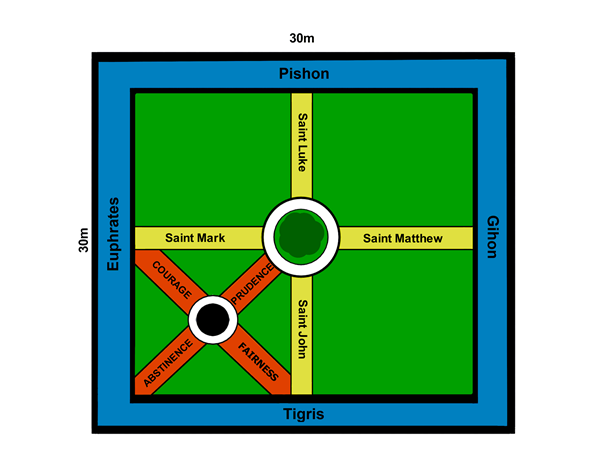
LEGEND:
I. The Recollection of the Old Testament (the image of Eden):
THE WELL

“…and a mist was going up from the land and was watering the whole face of the ground” Genesis 2:6

THE GREENERY – exclusively the plants mentioned in the Bible i.e. approximately 100 confirmed and 100 presumed species
“And God said, “Let the earth sprout vegetation, plants[e] yielding seed, and fruit trees bearing fruit in which is their seed, each according to its kind, on the earth.” And it was so.” Genesis 1:11
THE TREE – symbol of the Tree of the Knowledge of Good and Evil

“The tree of life was in the midst of the garden, and the tree of the knowledge of good and evil.” Genesis 2:9Genesis 2:9

THE RIVERS
“A river flowed out of Eden to water the garden, and there it divided and became four rivers.” Genesis 2:10
II. The Recollection of the New Testament (the Four Evangelists)

THE PATHS TO CRUCIFIXION (the Gospels) (perpendicular)
The death of Christ on the Cross abolished the Original Sin, opening the path to salvation.

THE WELL – the source of the life giving water. Jesus waits in the sacrament of Reconciliation
“Everyone who drinks of this water will be thirsty again, but whoever drinks of the water that I will give him will never be thirsty again. The water that I will give him will become in him a spring of water welling up to eternal life.” John 4:13-14
III. The Recollection of how the Pious Life is Unattainable Without the Fundamental VirtuesTHE PATHS TO CRUCIFIXION (diagonal)

Symbol of strength to live righteously through the Fundamentel Virtues, which merge the sacral and profane life.
“[..] For if God is man’s chief good, which you cannot deny, it clearly follows, since to seek the chief good is to live well, that to live well is nothing else but to love God with all the heart, with all the soul, with all the mind; […]” St. Augustine, “On the Morals of the Catholic Church.” from: Augustin: The Writings against the Manichaeans and against the Donatists, ed. Phillip Schaff, Hendrickson Publishers, 1995, p. 54.